

Designing meeting rooms for performance, wellbeing, and the future of hybrid collaboration
The meeting room redefined
The meeting room has always been an important room in any modern office-based workplace. This is the place where decisions are made, strategies take shape, and relationships evolve. However, the modern workplace has fragmented into hybrid modes: people flow between home, office, and client sites.
Consequently, meeting rooms must now do more than accommodate a table and a screen; they must be multi-purpose, cater to differing work styles, blend style with functionality. In short they must translate human collaboration into spatial performance.
Recent research from Microsoft’s Work Trend Index shows that 42% of employees feel disconnected during hybrid meetings, largely due to poor technology, poor sightlines, and uninviting environments. Similarly, the British Council for Offices (BCO, 2023) notes that meeting rooms are among the most frequently misused and acoustically underperforming zones in contemporary workplaces.
The challenge is clear: today’s meeting room must function as a spatial, technological and psychological interface, and be set up to help boost engagement, focus and wellbeing simultaneously.
Why meeting-room design standards matter
A “good” meeting room in 2025 isn’t subjective; it’s measurable. Meeting room layouts must comply with quantifiable meeting room standards that span geometry, light, sound, and air.
BS EN 12464-1:2021 defines illuminance and glare criteria for visual comfort.
AVIXA DISCAS set empirical methods for display size and contrast.
BS EN ISO 3382-2 quantifies reverberation time for speech intelligibility.
BCO (2023) and WELL Building Standard v2 extend those principles to wellbeing — integrating daylight, air quality, and biophilic design as measurable performance drivers.
These frameworks provide the foundation; the art lies in integrating them with human and organisational behaviours.
1. The anatomy of performance: AV-first geometry and acoustic integrity
Camera-centric layouts
Modern meeting rooms must be camera-first, not table-first. Now that hybrid working, working from home, and working in multiple different locations are the norm, consideration of camera placement is crucial.
Camera placement at eye level, centred between dual displays, ensures equal representation for all participants. For rooms with long tables, secondary cameras should address the far end, maintaining consistent eye contact.
Acoustics: designing for speech, not echo
The best microphone array can’t compensate for a reverberant space. Acoustic targets should be explicit: RT₆₀ between 0.4–0.6 seconds for small/medium rooms (BS EN ISO 3382-2).
Use Class A absorptive ceilings, wall panels at reflection points, and soft furnishings to dampen flutter echoes.DIN 18041offers guidance for speech rooms by volume. For openable rooms, acoustic zoning or retractable partitions should preserve privacy when divided.
Lighting for both faces and screens
Design to BS EN 12464-1 and CIBSE LG7, layering ambient and vertical illumination. Avoiding downlights directly above faces is paramount; instead use frontal, diffuse sources at 30–45° angles for natural facial rendering on camera. AVIXA’s RP-38-17 specifies vertical face illuminance and modelling ratios. Colour temperature should remain consistent (ideally 3500–4000 K), with high CRI (>90) to flatter skin tones and minimise fatigue.
2. Beyond AV: the human layer of meeting-room design
Biophilic design and natural light
Daylight remains the strongest circadian cue. WELL Building Standard suggests maintaining a Daylight Autonomy (DA300/50%) in occupied zones, while BCO guidelines emphasise maintaining <8 m depth from window wall to the back of a room for daylight penetration.
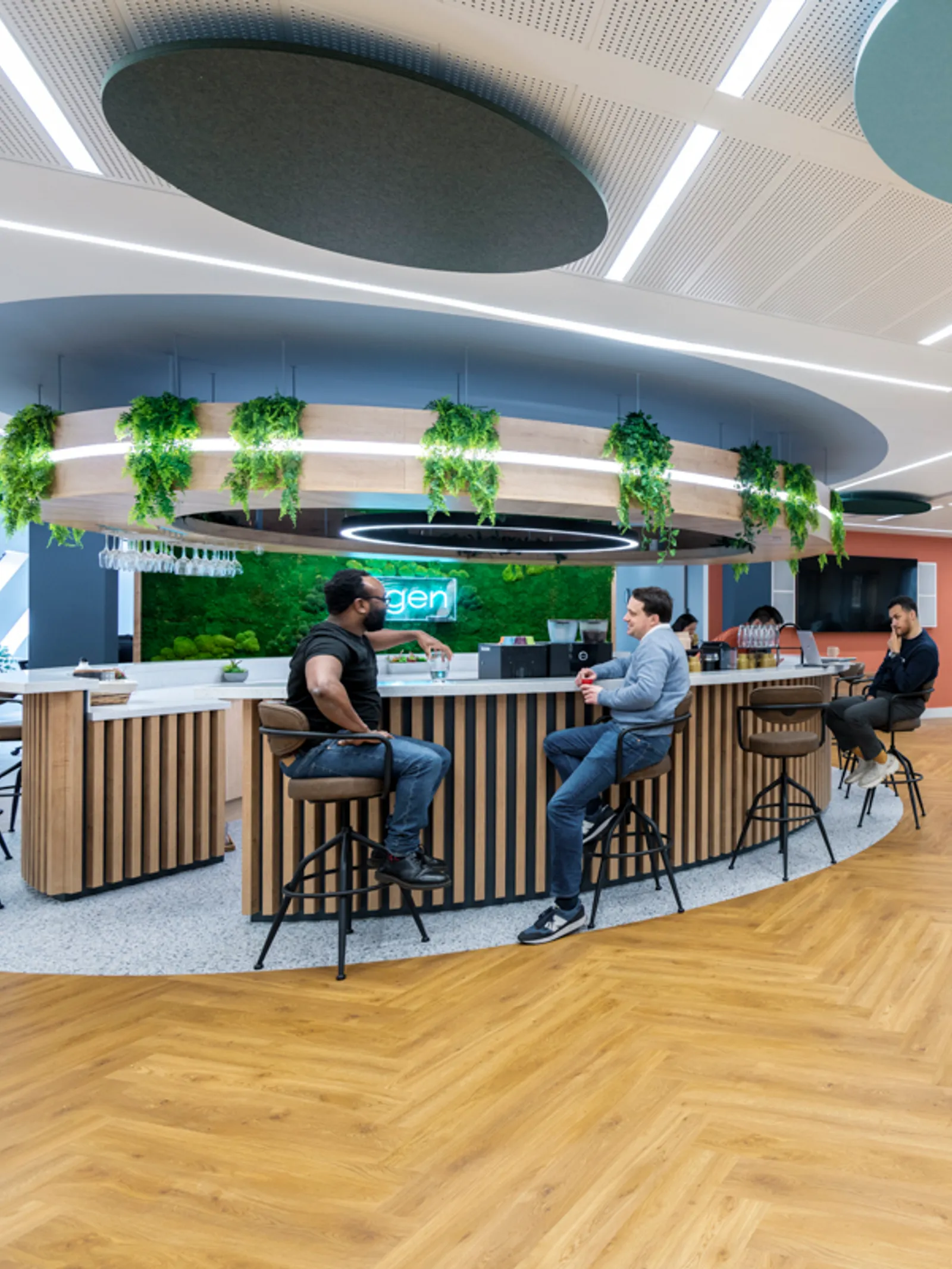
Incorporating greenery (living walls, potted plants, or moss panels) can reduce stress and boost attentiveness. A University of Exeter study found 15% productivity gains in offices with visible biophilic elements. Timber, stone, and textured materials add tactile warmth that balances the technical aesthetic of screens and glass.
Air quality and comfort
Harvard’s COGfx studies linked improved air quality to 61% higher cognitive scores, echoing BCO’s recommendation of 10–14 L/s/person of fresh air and CO₂ < 800 ppm. Air quality sensors should integrate with the building management system, triggering ventilation on demand. Meeting rooms, often heavily occupied, benefit from displacement ventilation or concealed plenum supply that maintains acoustic integrity.
Ergonomics and posture
Office designers are no strangers to ergonomic furniture, and demands for furniture that delivers ultimate comfort and flexibility is only set to increase. Ergonomic furniture design extends beyond the chair: consider table height variation (720–750 mm typical), leg clearance, and visual reach for screens.
Chairs should be easily adjustable and lightweight to encourage spontaneous reconfiguration. For long sessions, seat design should promote micro-movement, preventing fatigue. Accessibility standards (BS 8300-2:2018) should be explicitly applied to ensure inclusive reach ranges and manoeuvring space.
Flexible and reconfigurable furniture
The most effective meeting suites are modular ecosystems.
Huddle zones for 2–4 people: agile, with café-height tables and integrated displays.
Project rooms for 6–8: mobile tables, writable walls, plug-and-play utilities.
Boardrooms for 12+: fixed infrastructure but movable peripheral seating and secondary zones for breakout work.
Magnetic whiteboards, foldable tables, and mobile displays allow instant reconfiguration—from brainstorming to client presentation—without needing FM support.
3. Technology that serves collaboration, not complexity
Modern “collaboration surfaces” such as merge touch, inking, and video capture. They align with the ISO 9241-210 standard on human-system interaction—reducing cognitive load through intuitive interfaces.
The best spaces integrate analog and digital tools: a writable wall adjacent to a camera field ensures physical notes are captured in the video stream.
Connectivity and inclusivity
Wired and wireless connectivity must coexist. Power and data grommets at every seat (or floor boxes at 1.2–1.5 m intervals) prevent cable clutter.
USB-C power delivery, HDMI passthrough, and inductive charging pads now represent baseline expectations. Inclusive design means ensuring these connections are accessible to all users, including those with limited reach or mobility.
Scaling up: room typologies and layout logic
Room Type | Typical Capacity | Layout Priorities | Acoustic Target | Standards / Notes |
Huddle | 2–4 | Small trapezoid table, single display, high daylight | 0.4 s RT₆₀ | DISCAS (BDM) |
Small | 4–8 | Dual display (people/content), mobile furniture | 0.45–0.55 s | BS EN 12464-1; RP-38-17 |
Medium | 8–12 | Chevron layout, camera centrality | 0.5–0.6 s | BS EN ISO 3382-2 |
Boardroom | 12–20+ | Dual cameras, balanced lighting, formal aesthetic | 0.6–0.7 s | ISCR; DIN 18041 |
Flexible collaboration zone | Variable | Writable surfaces, moveable partitions, biophilic boundary | 0.45–0.6 s | WELL v2; BCO 2023 |
Other meeting room design considerations: Psychology, sustainablity & measurable metrics
The psychological dimension: design that supports cognition
A well-designed meeting room reduces cognitive friction.
Colour psychology: muted tones (sage, sand, slate) support focus better than high-saturation hues.
Texture and tactility: soft furnishings dampen echo and provide sensory grounding.
Lighting temperature: tunable white (3000–5000 K) allows circadian alignment—warm for early mornings, cooler for mid-day sessions.
Spatial diversity: a suite of different room sizes encourages choice and autonomy, linked to improved wellbeing in research by Leesman Index (2024).
Sustainable meeting room design
Sustainability in meeting spaces is measurable too.
Embodied carbon can be reduced with modular, demountable furniture systems.
Energy use falls with adaptive lighting (occupancy sensors, daylight harvesting).
Circular procurement, leasing AV equipment or specifying remanufactured tables—aligns with BREEAM 2023and LETI carbon benchmarks.
Metrics to consider when designing an office meeting room
RT₆₀: 0.4–0.7 s, measured per BS EN ISO 3382-2.
Lighting: 500 lux horizontal, 150 lux vertical to face plane, CRI > 90 (BS EN 12464-1, RP-38-17).
Display legibility: DISCAS/ISCR verified for the farthest viewer.
CO₂: < 800 ppm (BCO/WELL).
Daylight factor: ≥ 2% average (WELL v2).
Reverberation and background noise: NR 35 max for speech clarity.
Reconfigurability: < 10 min re-layout time per meeting type (internal benchmark for agile workplaces).
In summary
The evolution from huddle to boardroom reflects perhaps a more significant and wider-reaching truth: that meeting spaces are no longer passive enclosures, rather they are instruments of performance that can impact your business productivity and profitability. When office design aligns technology, wellbeing, and adaptability, meetings become shorter, clearer, and more human.
The next generation of meeting room layouts will be defined not by table size, but by meeting room standards that integrate acoustics, light, air, ergonomics, and biophilia into one seamless system.
Design from the lens back, but finish with the human in mind. Because when rooms are built for clarity, comfort, and connection, they don’t just host meetings; they supercharge momentum, promote collaboration and can make a significant difference to your business success.