

Hybrid Office Design

Enhance your working environment to suit both remote and collaborative working with hybrid office design. Maximise your potential.


Why hybrid is the future of office design
We are here to bring your vision to life. In the initial stages, we will work closely with our clients to define exactly what they are looking for in an office space. More and more businesses are moving towards a hybrid working model and we are here to make this transition as smooth as possible. Designing and reconstructing your office space to suit both collaborative and remote working through technology integration, layout, furniture and careful planning.


Why you should optimise for flexibility
Hybrid office design incorporates and promotes, above all, flexibility - adapting your working environment to the needs of all employees and their working preferences. By creating an office space that is optimised towards a hybrid working model, you open up the opportunity for as much social connectivity as you desire. We focus on delivering a bespoke, seamless service, with a fast turn around, mitigating downtime, so that you can step back into your highly optimised, new working environment and get on with what you do best.


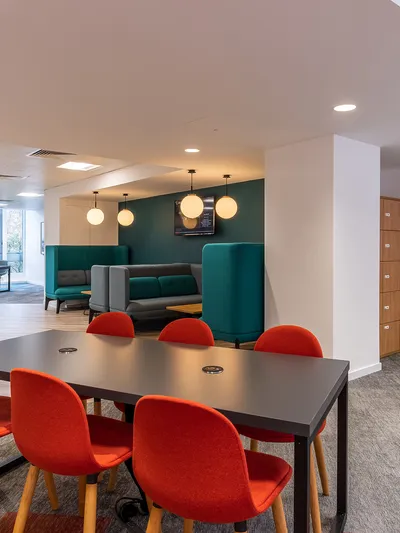


How to increase productivity and wellbeing with a hybrid office design
We value the needs of our clients and their needs to create an inclusive, positive working environment through workspace optimisation. Throughout the consultation, design and fit out stages, we adapt our strategy to your individual space, capabilities and requirements. You tell us your unique vision, and we will create a turnkey solution that ensures your employees wellbeing and productivity is prioritised.


Why choose a hybrid office design?
Hybrid office design bridges the gap between remote flexibility and office-based collaboration. By diversifying your workspace into "zones" for focus, social interaction, and teamwork, you empower employees to choose the environment that best suits their daily tasks. This approach reduces overheads, boosts productivity, and ensures your talent remains engaged.
What is hybrid office design?
Hybrid office design is a strategic spatial layout that supports a workforce split between home and the office. Unlike traditional layouts that assign one desk per person, a hybrid office focuses on fluid environments. It treats the office as a destination for high-value interaction while providing "quiet zones" for concentrated work.
Often called agile or flexible working, hybrid offices have slightly different work environments from ‘standard offices’. To get a greater picture of what is required, read our guide to what flexible working is now.
Hybrid Office Design FAQs
What are the benefits of hybrid working?
There are many benefits of hybrid working; both for businesses and employees. Allowing the option for remote or in-office working, offers more support to employees, accommodates to different working preferences and helps promote a stronger work-life balance. This model allows for a more self-managed working approach, that places more trust in employees and offers a larger balance between work and personal life, leading to higher productivity and retention.
What factors should you consider for hybrid office design?
When it comes to hybrid office design, the main factors you should consider are:
Layout and structure - consider all working styles and preferences and design an office that accommodates for both remote, in-person, collaborative and quiet working.
Technology - if your business allows for both remote and office-work, understanding the technical capabilities your space will require is an important step in ensuring your workplace functions for all types of working, and permits connectivity between those online and those in person.
Comfort and functionality - making sure that your office space, for those that work in-person is a comfortable, and highly functional space, optimised for productivity will allow for your hybrid working model to act seamlessly, where employees can easily connect with others through an optimal designed space and quality amenities.
Is hybrid right for your business?
While hybrid design is the gold standard for many, certain sectors or business models may require different approaches.
Coworking Hubs: If you are not ready for a dedicated space, you might consider the debate between coworking and traditional offices.
Specialised Sectors: Educational institutions have unique requirements. Learn about the five fundamentals of education interior design for tailored advice.
Standard Fit Outs: If you require a more conventional commercial space, it is vital to understand the difference between Category A and Category B fit outs.
How does hybrid design differ from traditional procurement?
Hybrid design focuses on adaptability and employee choice. This often requires a "Design and Build" approach to ensure the physical space integrates perfectly with the necessary technology, rather than using rigid, traditional procurement methods.
Explore the benefits of Traditional vs Design and Build for more clarity.
What if a full hybrid redesign is not right for us?
If a full cultural and physical shift feels premature, you might consider a Category A Plus fit out. This provides a "plug and play" office environment that offers flexibility without the need for a bespoke redesign.


